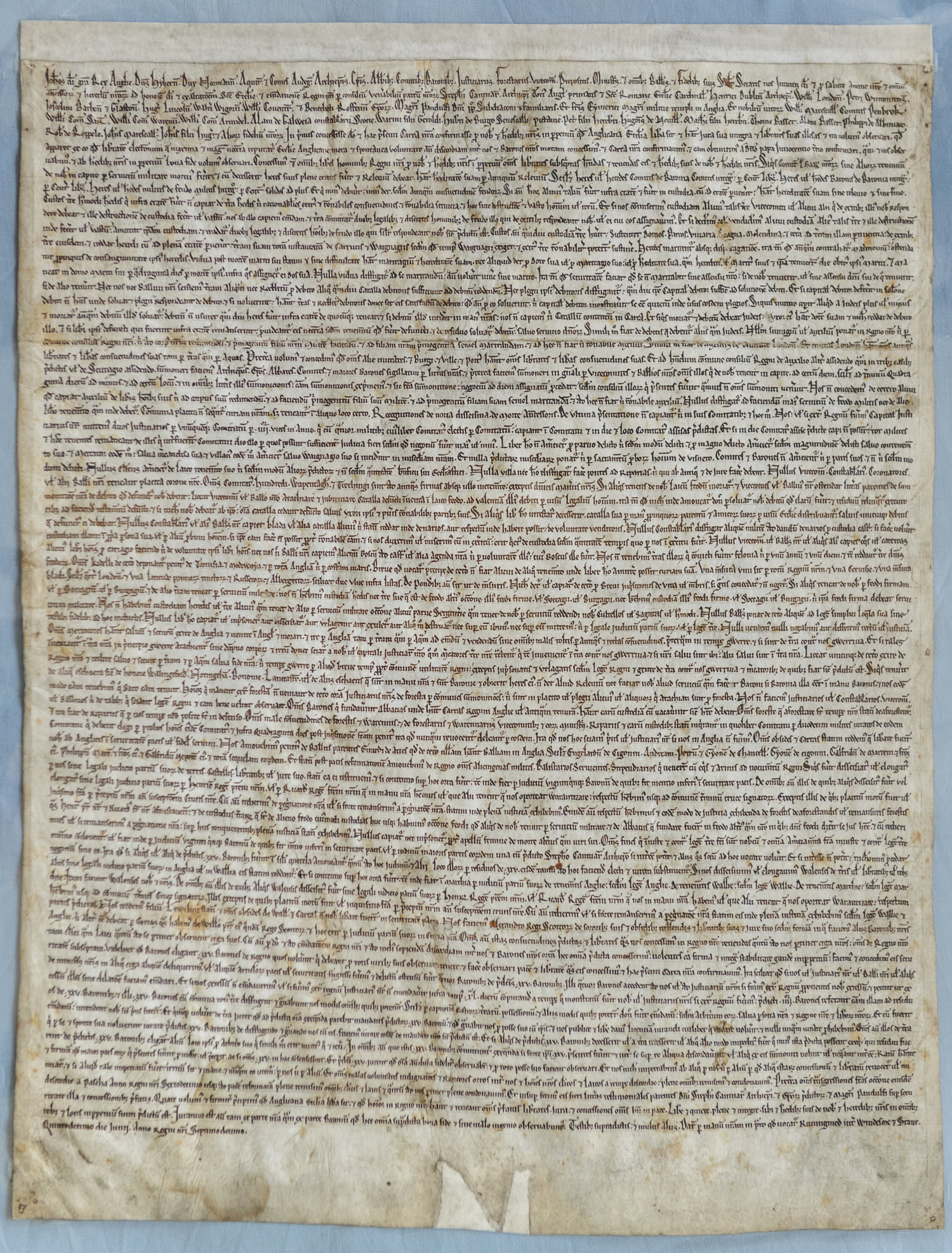
A very under appreciated tool in genealogy and misunderstood legal doctrine is the dower right. Long established in common law, it was codified as early as 1215 in the Magna Carta (in modern English):
(7) A widow, after the death of her husband, is immediately and without any difficulty to have her marriage portion and her inheritance, nor is she to pay anything for her dower or her marriage portion or for her inheritance which her husband and she held on the day of her husband’s death, and she shall remain in the chief dwelling place of her husband for forty days after her husband’s death, within which time dower will be assigned her if it has not already been assigned, unless that house is a castle, and if it is a castle which she leaves, then a suitable house will immediately be provided for her in which she may properly dwell until her dower is assigned to her in accordance with what is aforesaid, and in the meantime she is to have her reasonable necessities (estoverium) from the common property. As dower she will be assigned the third part of all the lands of her husband which were his during his lifetime, save when she was dowered with less at the church door. No widow shall be distrained to marry for so long as she wishes to live without a husband, provided that she gives surety that she will not marry without our assent if she holds of us, or without the assent of her lord, if she holds of another.
Married women were not able to own property separately from their husbands; Before marriage, a woman was a separate legal person: she could own property, make contracts, sue and be sued, and control her own wages. Using a legal process called coverture, marriage merged the legal identities of husband and wife into a single unit — and that unit was the husband.
This inability to own property meant that upon the death of the husband, property and inheritance would be in a legal limbo. Historically, King John (from the Magna Carta) abused this legal limbo in an attempt to raise money after losing Normandy to the French. Prior to King John, noble (property owning) widows would have to request permission from the king to remarry. This was likely to ensure that the king’s enemies wouldn’t acquire land or power, but King John used it as a revenue generator for the crown by “selling” the remarriage to widows to foreign mercenaries or allowing widows to pay for the right to not remarry. This was unpopular, and the dower was established to give widows the right to not remarry unless they want to, and to enjoy their portion of their inheritance from their husbands tax free.
Years later, English Common Law would define the wife’s dower rights included 1/3rd of all lands acquired or owned during coverture.
ALABAMA COMMON LAW
Alabama officially became a state on 14 Dec 1819 after splitting from the larger Mississippi Territory. The Constitution of Alabama never explicitly incorporates English Common Law, but followed a legal tradition of newly formed states and territories called “reception statues” to incorporate it. A great explanation of the process comes from Ford W. Hall in 1951:
Further to the south, Congress in 1798 established the Mississippi Territory and provided that the Ordinance of 1787 for the Northwest Territory should extend to the Territory of Mississippi with the exception of the article forbidding slavery. The United States Supreme Court several years later declared that this extended the common law to all the territory, and thereby all other law, Spanish or French, was excluded. “Continuation in force” clauses have kept the common law as the basis of judicial decisions in the state of Mississippi and also in Alabama until 1907 when for the first time an express reception statute was passed by the Alabama legislature.
ALABAMA DOWER LAWS
I will reference John A. Cuthbert’s book Compendium of the Law of Executors, Administrators, Guardians, and Dower, in Force in Alabama (1850), which is a legal reference book that summarizes the laws of Alabama as they existed at the time. The dower laws in Alabama evolved over the decades. The first big change to dower laws in Alabama was “Married Women’s Property Act of 1847” and dowers were officially eliminated in 1982- this post will try to explain concepts that have been important to my research into family history and how they may have differed over time.
Common Law As It Applies Until 1847
These are the rules legally followed until 1847, when laws on the dower started to change in Alabama. It should be noted that changes to parts of the dower law did not remove or change the rest of the law. Unless specifically changed, the rules as written stayed as written and continued to apply.
As noted in Cuthberts book:
The rights of parties married prior to the passage of the act of 1847, are governed by the law, as it existed at the time of their marriage. It has therefore been necessary, wherever these rights have been considered in this treatise, to explain the law in force before the act of 1847.
Only marriages that occurred on or after 1847 would be affected by new laws.
Order of Heirs:
In the descent of the estate of an intestate, there is no difference between real and personal property. An interest in an estate held jointly, on the death of a joint owner, intestate, descends to, and is vested in his heirs, or other legal representatives. CI Dig. 191, sec. 1. lb. 1
The estates of intestates descend to their next of kin, in the following order.
1st. To a child, or to children in equal parts.
2d. To brothers, and sisters, in equal parts.
3d. To the father.
4th. To the mother.
5th. To the other next of kin, computing according to the civil law.
Death timeframe before Administration
Administration in chief should not be granted until fourteen days after the death of the intestate, unless for special cause the court should think proper to grant it sooner.
Application: This seems to indicate that normally Administration of an intestate death starts about 2 weeks after his or her death
Administrator Selection Order
Administration is to be granted to the widow, or the next of kin, or some of them. If they refuse, it is then to be granted to one or more of the principal creditors of the deceased. If they also refuse, administration may be granted to such other (trustworthy) person as will accept. CI. Dig. 220, sec. 1.
…
Under ordinary circumstances, in granting administration, the court prefers the widow to the next of kin, but there may be considerations to induce it to prefer some of the next of kin.
In determining who are the next of kin, the rule is observed, which has been established for the descent of estates. A child is in the first degree, a brother or sister is in the second, the father is in the third, the mother is in the fourth, and then follow the other next of kin, computing according to the rules of the civil law. But the supreme court has decided, that the father should be preferred to the brother or sister.
Age of Administrators and Executors
If a person appointed sole executor, or he to whom in case of intestacy the right of administration appertains, be within the age of seventeen years in the one case, or of twenty-one years in the other case, the probate court may appoint an administrator “durante minore aetate”. It is the general practice of the court to grant this administration to the guardian of the minor, or to the husband of a minor, feme covert. In the case of an infant executor, this administration terminates, when he becomes seventeen years of age ; but in the case of an infant entitled to the administration, it continues until he arrives at twenty-one years of age. If the administration be during the minority of several infants, it terminates when the eldest of them becomes of the lawful age.
Application: A sole executor must be 17 years old to act. A person entitled to be administrator (when there is no will) must be 21 years old.
Wives cannot be Administrators
Coverture is not a disqualification for administration. When the wife is entitled, and the grant is made to her, the husband becomes joint-administrator, and the wife cannot control the assets, or the acts of her husband in disposing of them, and citation to him alone is sufficient. 5 Port. 64, Pistole v. Street, admr. 6 Port. 184, Williamson, et al. v. Hill. 16 Al R.817, Kavanaugh and wife v. McGehee and Armstrong.
Application: Married women cannot control property (see above), their husbands become de facto administrators.
Bond Requirements
Before the grant of letters testamentary, or of administration, every executor and administrator must enter into bond, with at least two sufficient securities, to be approved by the judge oT probate, payable to him and his successors in office, in an amount at least double the estimated value of the property of the estate, including its land, well and truly to perform the duties required of him by law, as such executor or administrator. Bond is not in general required of the executor, when the testator has, in his will, directed that it shall not be required. But when, after grant of letters testamentary, any creditor, legatee, distributee, or heir, shall make affidavit setting forth the amount of his claim, and that he believes it to be endangered by such grant, if the court shall believe that the estate will probably be wasted, it may require the executor to give bond with security. CI. Dig. 221, sec. 3. CI Dig. 229, 44. Act of 1847, p. 106. CI. Dig. 301, 25.
Application: Exceptions were made, but this requirement was used to make sure that the law was followed. Sureties were generally well off neighbors.
Dower
The widow’s dower consists of one-third part of the real estate, of which her husband died seised, or which he had conveyed during coverture ; that is, of all the real estate of which he was seised during coverture, as her estate during her natural life. It will comprehend the dwelling-house generally occupied by the husband, next before his death, with the offices, outhouses, buildings, and other improvements appurtenant thereto. But if it should appear to the court, that the whole of the said premises cannot be allotted to the widow, without injustice to the heirs, then the widow must be endowed with such part only, as the court shall deem reasonable. And she has a right to dower, in lands held to the use of, or in trust for her husband. CI. Dig. 172, sec. 3. lb. 157, sec. 6. 3 St. and Port. 447, Gillespie et al. v. Summe7’ville. 14 Al. R. 286, Ing V. Murphy. lb. 370, Edmondson v. Montague.
But if there are no children of an intestate, nor descendants of them, the widow will be entitled to one-half of the real estate, of which her husband died seised. CI. Dig. 168, sec. 2.
Of the personal estate, the widow is entitled to a share, in absolute right, according to the following scale. If there be no child, or but one child, she must have one-half, the debts of the deceased being first paid. If there be more than one child, but not more than four, she must have a child’s part. If there be more than four children, she must have one-fifth part. But this is not strictly dower ; nor is it a right by descent. CI. Dig. 173, sec. 4.
Feme Covert (married woman)
A feme covert, either over or under twenty-one years of age, may relinquish her dower. To make relinquishment of dower valid, there must be an acknowledgment to that effect, by her, on a private examination, apart from her husband, before a judge of the circuit or probate court, a justice of the peace, a clerk of the circuit or county court, or a notary public, stating that she signed, sealed and delivered the deed of relinquishment, as her voluntary act, freely, without any fear, threats or compulsion of her husband ; and there must be a certificate thereof, written on or under said deed, and signed by the officer before whom the acknowledgment was made. CI. Dig. 174, sec. 9. lb. 155, sec. 27. lb. 157, sec. 39, 40.
When a deed from the husband, without relinquishment of dower, has been recorded, the wife may subsequently relinquish her dower, by acknowledgment, as heretofore stated ; and such acknowledgment must be recorded where the conveyance of the husband has been recorded. lb. 155, sec. 28.
When a feme covert shall join with her husband, in the execution of a deed of conveyance of land, in the presence of two or more credible witnesses, or shall acknowledge such deed, before any person authorized by law to take acknowledgment of deeds ; her right of dower in the lands conveyed, will be thereby perpetually barred. CI. Dig. 174, sec. 10.
To be continued – if I am wrong, please comment and let me know so I can strive to be as correct as possible!
 NorthEast Alabama Families
Leave a comment